29
Sep

Leg Length Discrepancy Shoes, Insoles & Treatments: The Complete Muscat Guide
A slight hitch in a child’s step, persistent lower back fatigue after standing, or an uneven walking gait often traces back to a condition known as leg length discrepancy (LLD), commonly referred to as having uneven legs. In children and adults across Muscat and the wider Sultanate of Oman, leg length differences can quietly affect daily comfort, running mechanics, and long-term joint health.
Addressing this asymmetry requires accurate clinical diagnosis to determine whether the difference is anatomical or functional, and whether conservative footwear modifications are necessary. When intervention is warranted, specialized leg length discrepancy shoes, custom orthotic insoles, and climate-appropriate sandals provide calibrated millimetric elevation to level the pelvis, decompress the lumbar spine, and restore a symmetrical gait cycle.
What Is Leg Length Discrepancy (LLD)?
Leg length discrepancy occurs when one lower extremity is measurably or functionally shorter than the other. Orthopedic clinicians classify LLD into two primary categories:
1. Structural (Anatomical) LLD
Structural LLD occurs when there is a true physical difference in the length of the femur (thigh bone), tibia (shin bone), or talus/calcaneus complex.
- In Children: Structural differences commonly stem from congenital limb conditions (such as fibular hemimelia), growth plate (physeal) fractures, pediatric bone infections, or neuromuscular conditions.
- In Adults: Structural discrepancies frequently develop after traumatic fractures, malunions, or joint surgeries—most notably total hip replacements, where leg equalization can sometimes be constrained by anatomical stability requirements.
2. Functional (Apparent) LLD
Functional LLD occurs when the actual bone lengths are identical, but pelvic asymmetry or soft tissue imbalances cause one limb to act shorter than the other. Typical causes include pelvic obliquity, sacroiliac joint rotation, lumbar scoliosis, unilateral hip muscle contractures, or severe unilateral flat foot (excessive foot pronation that lowers the ankle joint on one side).
When Is Treatment Needed vs. When Is It Not?
Absolute human symmetry is rare. Many active individuals live with minor limb variations without developing pain or functional limitation. Understanding when to treat and when to observe prevents unnecessary interventions.
When Treatment Is NOT Needed
- Asymptomatic Discrepancies Under 10 mm: Differences between 3 mm and 9 mm are standard across the general population. If an adult or child shows no compensatory pelvic tilt, no spine strain, and no joint pain, intervention is usually not indicated.
- Transient Pediatric Growth Spurts: Growing children frequently experience asynchronous growth where one leg momentarily outpaces the other. If gait remains fluid and painless, observation every 4 to 6 months is the preferred clinical approach.
- Purely Muscular or Postural Imbalances: Introducing an artificial shoe lift to a purely functional discrepancy can fixate pelvic rotations. These cases respond best to targeted physiotherapy, hip flexor release, and core stabilization.
When Treatment Is Essential
- Discrepancies Exceeding 10 mm: Structural asymmetries beyond 1 cm place measurable biomechanical strain on the kinetic chain. The pelvis drops toward the shorter side, creating compensatory lumbar curves (functional scoliosis) and uneven disc compression.
- Pain Syndromes: Recurrent unilateral knee pain, trochanteric bursitis, hip joint degeneration, plantar fasciitis, or chronic sacroiliac joint dysfunction.
- Pathological Gait Compensations: Visible pelvic tilt, vaulting (stepping up on the toes of the shorter leg during stance phase), or excessive knee flexion on the longer limb.
- Growing Children with Progressive Asymmetry: Structural limb discrepancies in children require consistent management to protect spinal development and prevent irreversible structural changes.
Clinical Biomechanical Reference: Discrepancy Severity & Solutions
| Discrepancy Range | Severity | Kinetic Chain Impact | Footwear / Treatment Strategy |
|---|---|---|---|
| 0 – 9 mm | Mild / Sub-clinical | Minimal; self-compensating via subtle pelvic adaptation | No treatment if asymptomatic; targeted physical therapy or 3–6 mm internal heel lift if symptomatic |
| 10 – 19 mm | Moderate | Pelvic tilt, functional scoliosis, unilateral knee/hip overload | Internal orthotic insole (up to 8 mm) combined with external shoe modification; specialized LLD sandals |
| 20 – 49 mm | Marked / Severe | Pronounced vaulting gait, elevated metabolic walking cost, disc strain | Full-length external midsole shoe build-up, custom orthopedic shoes, pediatric growth modulation |
| ≥ 50 mm | Complex / Surgical | Severe limping, extensive joint degeneration, postural exhaustion | Specialized orthotic bracing (AFO with integral lift), or orthopedic surgical limb lengthening/shortening |
How Corrective Footwear and Insoles Restore Alignment
Conservative treatment equalizes leg length to restore horizontal pelvic alignment, normalize ground reaction forces, and balance muscular workload.
1. The Critical Role of Leg Length Discrepancy Shoes
When a structural discrepancy exceeds 10 mm to 12 mm, inserting the entire correction inside a standard off-the-shelf shoe is impossible without crowding the foot or causing the heel to slip out. Exterior leg length discrepancy shoes solve this challenge:
- Full-Length Midsole Build-Ups: A qualified orthopedic technician carefully splits the outsole of a high-grade sneaker, school shoe, or work shoe, inserts a high-density, lightweight EVA or microcellular rubber wedge along the full length from heel to toe, and reapplies the original tread. This ensures equal ground clearance without pitching the foot forward.
- Forefoot Rocker Integration: Sole lifts that exceed 15 mm can stiffen the shoe base. Adding a subtle forefoot rocker sole helps maintain a smooth, effortless toe-off, preventing knee hyperextension during walking.
- Firm Heel Counters & Lateral Stability: Raising a shoe base elevates the center of gravity. Sturdy heel counters and wider soles are critical to prevent ankle rolling.
2. Flat & Supportive LLD Sandals for Warm Climates
Given the warm climate in Muscat, closed shoes are not always practical for everyday home and casual wear. Specialized LLD sandals provide an essential warm-weather alternative:
- Contoured orthopedic footbeds with built-in anatomical arch support and deep heel cups.
- Multi-point adjustable straps that secure the lifted foot precisely over the center of the platform.
- External sole build-ups integrated directly into the sandal outsole, enabling continuous postural balance around the home, school, or weekend outings.
3. Precision LLD Insoles and Heel Lifts
For minor to moderate corrections, internal LLD insoles offer a discreet and versatile option:
- High-Density Modular Heel Lifts: Positioned beneath the removable factory insole. They use firm cork, dense EVA, or medical-grade silicone that will not collapse under continuous body weight.
- Custom 3D-Scanned Orthotics: Custom insoles crafted from dynamic pressure scans provide exact millimetric elevation under the short leg while correcting coexisting conditions such as plantar fasciitis or excess pronation.
Accurate Assessment in Muscat: The Foundation of Proper Alignment
Guessing lift heights or using generic heel pads can worsen musculoskeletal symptoms; miscalculating by as little as 3 mm to 4 mm can redistribute forces into the knee or sacroiliac joint. Accurate care requires a systematic clinical protocol:
- Digital 3D Foot Scanning: Precise measurement of foot dimensions, volumetric distribution, and arch architecture under full weight-bearing conditions.
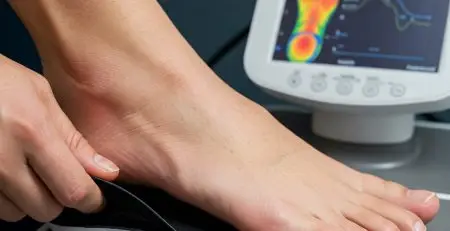
- Dynamic Foot Pressure Scanning: High-speed sensor plates track pressure distribution and gait timing through each phase of your step.
- Pelvic & Skeletal Assessment: Measuring anatomical landmarks from the anterior superior iliac spine to the medial malleolus, determining true structural shortening versus functional pelvic tilt.
Whether addressing a child’s developmental gait or relieving chronic adult postural pain, calibrated footwear modifications and precision orthotics provide a reliable, non-invasive path to balanced movement.
Disclaimer: This article is intended for educational purposes and should not replace tailored medical advice. Consult an orthopedic specialist or podiatrist in Muscat, Oman, for precise diagnostic evaluation and customized orthotic prescriptions.